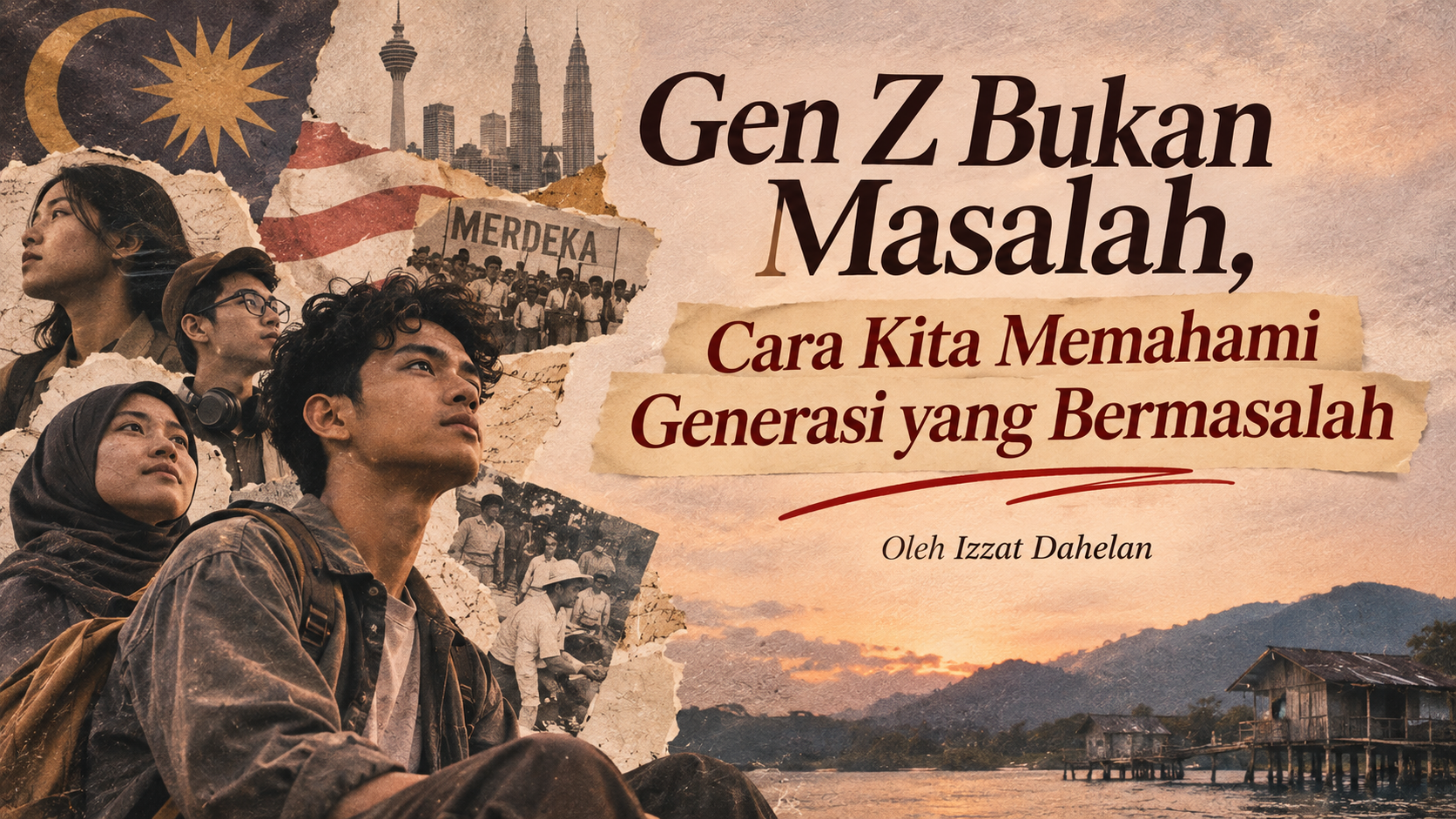
Gen Z Isn't the Problem. Our Understanding of Generations Is.
Why we should stop blaming Gen Z and start understanding the history that shaped them.
By Izzat Dahelan
There is a habit in our society that I find increasingly difficult to understand. Whenever young people behave in ways that older generations dislike, we immediately look for a generation to blame.
Young people cannot handle criticism? Gen Z. Young employees ask too many questions? Gen Z. Students no longer enjoy sitting through lengthy lectures? Gen Z again.
As though knowing someone's birth year is enough to understand everything about them.
We have turned generations into something resembling horoscopes. People born within a particular range of years are assigned a collection of characteristics, and we are expected to believe that millions of individuals somehow share the same personalities, attitudes and weaknesses.
Older generations are described as resilient. Millennials are said to be entitled. Gen Z is supposedly too sensitive. Gen Alpha is already being portrayed as a generation incapable of concentrating.
I think we have become far too comfortable making assumptions about people.
This is why I would like to recommend a fascinating conversation between Indonesian comedian and writer Raditya Dika and generational researcher Dr. Muhammad Faisal, titled Orang Ini Kerjanya Meneliti Generasi.
What makes this conversation worthwhile is that it goes beyond familiar arguments about young people. It challenges a more fundamental assumption: What actually makes a generation?
A generation is more than a birth year
One of the most compelling arguments Dr. Faisal raises concerns how we define generations.
We are familiar with the categories. Millennials are generally described as people born between 1981 and 1996, while Gen Z covers those born between 1997 and 2012.
These categories are convenient for demographic analysis. Malaysia's Department of Statistics has even adopted similar classifications in its population publications.
The problem begins when we treat these categories as explanations of personality.
A more meaningful way to understand generations is through shared historical experiences, particularly events that shape how people see the world during their formative years.
This argument resonates with sociologist Karl Mannheim's work on generations. Mannheim emphasised the importance of historical circumstances and social location in shaping collective consciousness.
In simpler terms, birth years help locate us in history. But the experiences we encounter within that history help shape who we become.
Consider two Malaysians born in 2000.
One grows up in Kuala Lumpur, surrounded by digital devices, reliable internet access and educational opportunities.
Another grows up in rural Sarawak, where internet connectivity is limited, access to schooling may require long journeys, and family responsibilities shape everyday life.
Both belong to Gen Z.
But can we reasonably assume that they share the same worldview, opportunities and aspirations?
This is where generational stereotyping begins to fall apart.
Malaysia has its own generational history
Another significant point in the podcast concerns the limitations of applying American generational categories directly to Indonesian society.
I believe the same criticism applies to Malaysia.
Terms such as Baby Boomers, Gen X, Millennials and Gen Z emerged largely from Western historical experiences. Yet Malaysian society has been shaped by a different set of historical circumstances.
Consider the Japanese Occupation, Malaya's independence in 1957, the formation of Malaysia in 1963, the events of May 1969, industrialisation, the 1997 Asian financial crisis, the 1998 Reformasi movement, the rise of the internet, political transitions and the COVID-19 pandemic.
Each of these events potentially shaped the attitudes, expectations and experiences of different groups of Malaysians.
Interestingly, a Malaysian study published in Media Asia identified generational cohorts based on historical events and collective memory rather than relying exclusively on American categories.
The researchers proposed groups such as the Pre-Merdeka, Merdeka, Reformists and Internet generations.
These categories are not definitive descriptions of every Malaysian. Nevertheless, the research demonstrates why local historical experiences matter.
The question becomes even more interesting when we consider Sabah and Sarawak.
A young person growing up in a well-connected urban neighbourhood may experience technological change very differently from someone living in a remote community.
The same historical event can have very different consequences depending on geography, social class, education and economic circumstances.
If we want to understand Malaysian generations, we need to ask more than when someone was born.
We must ask where they grew up, what opportunities they had, and which events shaped their lives.
Perhaps young people are not the problem
I find this especially relevant to education.
We often hear that today's students lack resilience, discipline, concentration and communication skills.
Some of these concerns deserve serious attention. But does attributing them to Gen Z help us understand their causes?
Or should we be examining changes in family life, educational inequality, digital environments and the learning disruptions caused by the pandemic?
When a student struggles to concentrate, saying "That's just Gen Z" explains very little.
What is the student's literacy level? What is happening at home? How much access do they have to learning support? What teaching practices have they experienced?
These questions are far more useful than generational labels.
The same principle applies in the workplace.
When young employees ask about working hours, well-being or the reasoning behind instructions, some employers interpret these questions as evidence of entitlement.
But they may also reflect changing expectations about employment, authority and personal life.
Not every demand is reasonable. Not every change represents progress.
Still, differences should not automatically be interpreted as generational decline.
Sometimes the environment has changed, and people are simply responding to that change.
Connected to everyone, close to no one
The podcast also explores a striking contradiction of digital life.
We can have thousands of followers and still feel profoundly lonely.
We know what distant acquaintances are eating, where former classmates are travelling and what strangers have accomplished. Yet we may know very little about the people living next door.
Our social networks have expanded, but our relationships have not necessarily deepened.
Dr. Faisal and Raditya Dika discuss anxiety, FOMO, hesitation and the ways digital culture influences how young people understand themselves.
Their discussion about romantic relationships is particularly interesting.
Social media exposes us to seemingly perfect relationships: expensive gifts, beautiful holidays, carefully planned surprises and endless declarations of affection.
We begin comparing ordinary relationships with extraordinary moments curated for public display.
The result can be a growing sense that our own lives are somehow inadequate.
Technology is not the only factor behind these pressures. But it has undeniably transformed the environments in which people form expectations about love, success and happiness.
Young people are also searching for hope
Another interesting part of the conversation concerns the growing appeal of content that offers hope.
When public conversations are saturated with uncertainty, anxiety and pessimism, people may turn towards stories that offer comfort, humour or a sense of possibility.
The podcast also examines why younger audiences sometimes enjoy absurd or unconventional comedy, and why philosophical conversations may help them navigate personal uncertainty.
I find these discussions valuable because they remind us that people are not merely products of technological trends.
They are human beings searching for connection, meaning and reassurance.
This is particularly important for educators, parents, writers and anyone working closely with young people.
Understanding a generation requires more than observing its behaviour.
We must also listen to its fears, aspirations and questions.
People are more complicated than labels
I am not arguing that generational categories should disappear.
They can be useful for demographic research, social planning and understanding broad patterns of change.
But they should serve as starting points for investigation, not final explanations of human behaviour.
History, social class, education, geography, family circumstances and personal experience cannot simply be erased by a label.
Perhaps we have been asking the wrong question.
Instead of asking, "Why is Gen Z like this?" we should ask, "What kind of world have we created for them to grow up in?"
That, to me, is the greatest value of this conversation between Raditya Dika and Dr. Muhammad Faisal.
It does not offer a complete theory of generations. Some arguments deserve further scrutiny and research.
But it encourages us to ask better questions.
And perhaps, before blaming younger people for failing to resemble the generations before them, we should listen to this conversation first.
People are not born with generational personalities.
They grow up within history.